“Interior design lit me up in a way that fitness hadn't.”
What work were you doing previously?
Before interior design, I was happily working as a fitness instructor and personal trainer.
I left school at 16 with very few qualifications. That same year, my family moved abroad and I took an office job for the summer. It was a revelation. For the first time, I was earning money, being treated as an adult and enjoying a level of respect I hadn't experienced at school. There was no way I was going back!
By 19, I'd fallen in love with fitness. I paid my own way through a five-month, full-time course to qualify as a fitness instructor and personal trainer, and enjoyed seven years of freelance work. I even dreamed of opening my own gym.
But then something unexpected happened. Shortly after buying my first home, I wanted curtains and couldn't afford to have them made. I'd inherited a sewing machine, so I bought a book (this was long before YouTube!) and taught myself to make them. People saw what I'd made and started asking me to make theirs. That small, practical solution eventually became the beginning of an entirely new career.
What are you doing now?
I still practise interior design, mainly as a consultant.
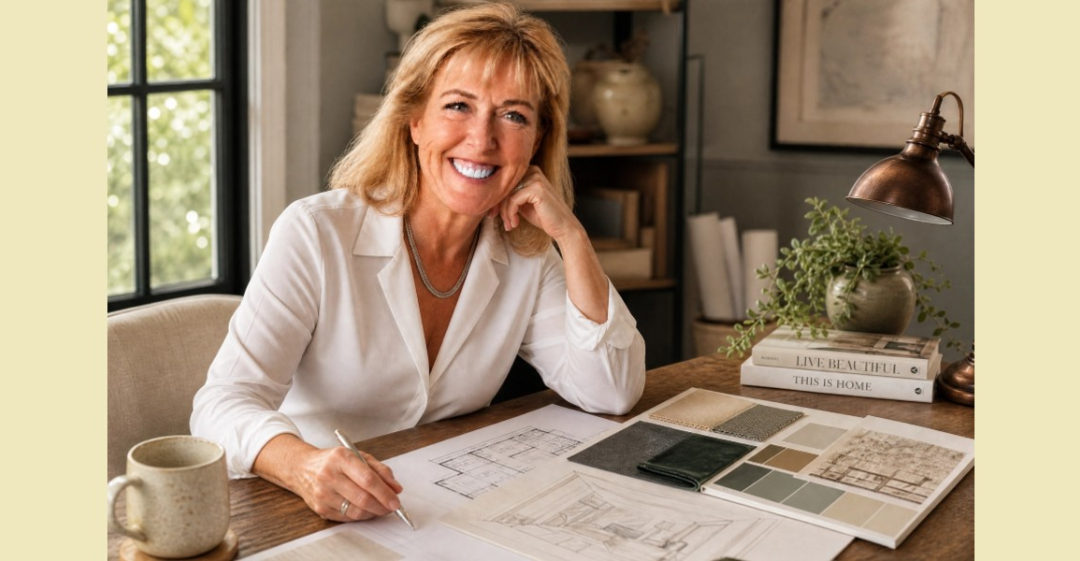
I teach adults who want to become professional interior designers. I've worked in design for more than 30 years and taught it for over 25.
I've founded and run two design schools, one of which grew to train thousands of students in more than 20 countries. But over time, I found myself spending more energy running an educational institution rather than doing the thing I loved most: teaching.
Like many people, Covid gave me an opportunity to reassess my working life. I realised how much of my time was being consumed by administration, bureaucracy and academic red tape, and how far I'd moved from the work that originally inspired me.
In 2025, I started IDTC, returning to what I enjoy most: teaching motivated adults, helping them develop their skills and watching their confidence grow. It's another chapter in a career I never planned!
Why did you change?
Honestly, I never planned to become an interior designer.
I made curtains because I couldn't afford to buy them and discovered something I absolutely loved. Interior design lit me up in a way that fitness hadn't. I could eat, sleep and breathe it without getting bored or feeling overwhelmed. Teaching turned out to be much the same.
One experience that had a lasting influence on me was discovering how difficult it could be to access education as an adult without the conventional academic qualifications. I was motivated, capable and absolutely determined to learn, yet I repeatedly came up against entry requirements that had little to do with my ability or commitment. I found that incredibly frustrating, and it stayed with me.
It became one of the driving forces behind my own approach to teaching. I wanted to create opportunities for people who had the ability and determination to build a new career, regardless of their academic history.
And there were other factors along the way, too. In 2001, a car accident left me largely immobile for a couple of years. Interior design can be physically demanding, and I was unable to practise it fully for some time. During that period, teaching gradually took on a more prominent role in my working life, while my design work shifted increasingly towards consultancy, particularly in the commercial sector.
I think we spend far too much of our waking lives working to spend those hours doing something that doesn't fulfil us. If you find something you're genuinely passionate about and can turn it into a living, I think that's better than winning the lottery.
When was the moment you decided to make the change?
There wasn't one defining moment.
My career has evolved through a series of opportunities, and each time I've had to decide whether I was prepared to take a different road.
Something I heard at a weekend workshop hosted by Wayne Dyer in the 1990s has stayed with me ever since. He was talking about following your dreams and overcoming the fear of financial uncertainty.
He told a story about walking around a supermarket with a packet of grapes in your trolley. It's easy to pop a few into your mouth as you go, he said. His point was that, in the worst-case scenario, you could always eat grapes!
Obviously, we can't live on grapes alone, but his message stuck. Whenever I've faced a big decision, I've asked myself: what's the worst that could happen, and could I live with it? Then I've compared that with the best possible outcome.
That simple way of looking at things has helped me take opportunities I might otherwise have been too frightened to pursue.
How did you choose your new career?
I didn't choose it from a list of possible careers.
It grew out of something I needed to do for myself, in my own home. I discovered I enjoyed making curtains, realised I had an aptitude for it and, when other people started asking for my help, I recognised there was a business opportunity.
Teaching developed in much the same way. I could see a gap in the education available to aspiring interior designers. I wanted to give people the things I felt had been missing from my own training, and to make learning an enjoyable, practical experience rather than simply a process of passing assignments.
In both cases, I followed something that interested me, recognised an opportunity and worked out how to develop it into something more substantial.
I've come to fully understand that the only constant in life is change. We have to be willing to adapt and remain open to possibilities we might never have considered.
Are you happy with the change?
Yes, absolutely.
Although that doesn't mean every stage has been easy or enjoyable. One thing I've learned through design is that you need to know what you want to achieve before you can work out how to get there.
When designing a room, I start with the finished result in mind and work backwards. I approach life in much the same way: decide where you want to be, then work out the steps needed to get there.
I also get enormous satisfaction from watching people discover what they're capable of. I don't often say this out loud, but seeing someone develop confidence, achieve something they didn't think possible and find work that feeds their soul is what feeds mine.
I think almost everyone experiences imposter syndrome at some point. It can be particularly damaging when you're contemplating a career change because we tend to underestimate what we're capable of. Sometimes we simply need to give ourselves permission to try.
What do you miss and what don't you miss?
What I miss most about being employed is the simplicity of it.
Starting at nine, finishing at five and being able to walk away without taking your work home with you. In the beginning particularly, I missed having a regular pay cheque and not being responsible for everyone else, from clients to staff.
What I don't miss is the lack of control over my own working life. Working for yourself brings an enormous sense of satisfaction. I love being able to shape what I do, how I do it and who I work with. There's also a financial reward in knowing that the better you become at what you do, the more value you can offer.
Money isn't my main motivation, but let's be realistic: it's important. I've found that when I concentrate on doing the very best job I can, the financial rewards tend to follow. I've also earned a much better living working for myself than I ever could have working for someone else.
How did you go about making the shift?
Very gradually, and initially in my spare time.
People started asking me to make curtains after seeing the ones I'd made for my own home. I fitted this work around my fitness classes and personal training, making curtains in the evenings and at weekends.
As demand grew, I bought a van so I could take fabric sample books directly to clients' homes. Eventually, I was busy enough to make the change to full-time work.
By the mid-1990s, I had established my own made-to-measure curtain and interior design business. I took the studio to the client, bringing fabrics, samples and designs into their homes so that every window treatment was chosen specifically for the space.
Clients gradually began asking for wider interior design advice. I had a good eye, but I knew my knowledge had limitations. Experience could only take me so far, so I decided to return to college as an adult, studying part-time around my existing commitments.
The state colleges wanted me to complete additional study before I could enrol, so I chose a private college and paid for the course myself. It was expensive, and my husband was understandably apprehensive, but I was determined. I saw it as an investment in myself and my business.
After qualifying, the college invited me back to give a guest lecture on designing window treatments. The students wanted me to return, and I was subsequently offered the opportunity to teach a one-year, part-time Diploma in Interior Design.
That one invitation changed the direction of my working life again. Teaching eventually led to my own design school and I went on to develop some of the world's first fully online university-level programmes in Art & Design, achieving international accreditation for HNC and HND programmes delivered entirely through distance learning.
At the time, many people in the industry insisted it couldn't be done. Looking back, each stage grew out of the one before it. I didn't need to have the whole journey mapped out. I just needed to take the next step.
How did you develop (or transfer) the skills you needed for your new role?
I've always loved learning, in whatever form it takes as long as it is effective.
I'm neither for nor against formal qualifications. I'll learn through a course, a book, observation or simply by doing something myself. The important thing is to keep learning.
I've always been particularly good at teaching myself. In my first office job, I realised that being able to type would make me more useful. The only available course involved one evening a week for an entire year. That seemed an awfully long time to learn one skill!
Instead, someone lent me a manual typewriter, I bought a book, covered the keys so I couldn't see the letters and taught myself. Within two weeks, I was touch-typing at 55 words a minute.
Making curtains was much the same. I taught myself because I needed to. However, self-teaching has its limitations. When I wanted to develop my interior design skills professionally, I needed proper training. My course gave me a valuable foundation, but it also highlighted how much I still needed to learn.
We were often told what to do without being shown how to do it. I remember receiving a blank board for our first sample-board assignment, with no examples or explanation of what it should contain. Assignments came back with a grade but very little constructive feedback.
I filled those gaps through experience, and when I began teaching, I made sure my own students received the practical guidance and feedback I'd wished I'd had.
One thing I'd particularly like people changing careers to understand is that they already have more transferable skills than they realise. You've probably managed projects, budgets, people, deadlines and countless unexpected situations.
Running a household, organising family life and making your money stretch are all valuable skills. Don't underestimate what you already bring to the table.
What didn’t go well? What wrong turns did you take?
I don't really believe in wrong turns.
There were certainly mistakes and difficult periods, but each one taught me something I needed to know.
Building a business takes time, and self-employment can be unpredictable. It's very easy to fall into the trap of accepting every job because you're worried another one might not come along. Before long, you're working excessively, chasing your tail and not necessarily doing the work you enjoy most.
One of my biggest early mistakes was underpricing myself. I worked far too hard for far too little, partly because I hadn't yet learned to recognise the value of what I was offering.
However, I had one rule: once I quoted a price, I stuck to it. I'd always disliked businesses changing their prices after agreeing a job, so I refused to do that to my own clients.
Over time, I learned to price my work properly. I think the honesty and reliability I'd established with clients helped my business grow. People knew they could trust me to deliver what I'd promised.
I also learned that experience alone could only take my design work so far. Going back to college gave me the knowledge and foundation I needed to move forward.
How did you handle your finances to make your shift possible?
My entire career change began because I didn't have money!
I made my own curtains because I couldn't afford to buy them. After that, I was very careful financially. I paid for my design training myself and studied part-time while continuing to work.
When I started my business, I approached my mortgage company, who I'd been with for ten years, explained honestly that I was setting up a business and asked whether they would consider a one-year mortgage payment moratorium. They agreed, which gave me some breathing space.
I also relied on credit cards for the first two years. I'd never previously carried debt, but I saw it as an investment in establishing my business. I wouldn't recommend that approach lightly, and it certainly wasn't comfortable.
When I launched the academy, there was another period when money was extremely tight. For about six months, we genuinely lived on beans on toast. My husband and I even argued over buying a can of Coke on one occasion!
It wasn't easy, and I don't want to give the impression that everything simply fell into place. There were sacrifices, uncertainty and some very difficult decisions. Having a shared vision with my husband helped enormously.
My advice would be to understand your finances before making a change. Work out what you can afford, what you can reduce and how long you can realistically manage while building something new. Passion is important, but so is being practical.
What was the most difficult thing about changing?
The financial uncertainty was probably the hardest part on a day-to-day basis.
Not knowing when the next job would come in, or whether there would be enough money to cover everything, can be very stressful. There were also the usual challenges of building something from scratch: finding clients, establishing a reputation and learning to trust that things would work out.
But I learned that determination and a willingness to keep learning can take you a very long way. You don't need to have everything in place before you begin; sometimes you just need to be prepared to find another way forward.
What help did you get?
To be honest, I didn't receive a great deal of practical help along the way.
Much of what I achieved came from working things out for myself, taking responsibility and being prepared to put in the effort. However, one invitation made an enormous difference. After completing my interior design training, my old college asked me to return as a guest lecturer.
That single opportunity opened the door to a completely new career in teaching. I sometimes wonder what would have happened if that invitation hadn't arrived. It also taught me something important: you never really know which small opportunity might change the direction of your life.
What have you learnt in the process?
Quite a lot!
Firstly, a career change doesn't have to start with a grand plan. Mine started with a pair of curtains.
Secondly, teaching yourself is a wonderful skill, but you also need to recognise when you've reached the limits of what you can learn alone. There's no shame in seeking proper training or asking for help.
I've also learned that qualifications and ability are not the same thing. A qualification can provide a valuable foundation, but it doesn't automatically make someone talented, capable or committed.
Finally, I've learned that good teaching makes an enormous difference. People need to see examples, understand how to do something and receive constructive feedback. Simply being given an assignment and a grade isn't enough to help someone develop.
Most importantly, I've learned that we're often capable of much more than we give ourselves credit for.
What do you wish you'd done differently?
I don't think I'd change anything fundamental.
There are certainly things I wish hadn't happened, and some experiences I'd happily have avoided, but they've all contributed to who I am and where I've ended up.
I might've made some decisions differently with the benefit of hindsight, but that's the advantage of hindsight! We make decisions based on what we know and understand at the time.
I think it's more useful to learn from those experiences than spend too much time wishing we'd taken a different path.
What would you advise others to do in the same situation?
Start with what you can do now.
You don't need anyone's permission to begin learning something new. Try it for yourself, explore it, and see whether you genuinely enjoy it before making major financial or career commitments.
Don't let a lack of formal qualifications convince you that a new career is out of reach. There may be alternative routes into the profession, and the first door you knock on may not be the right one. Be prepared to look for another way.
If you decide to undertake training, look carefully at how you're going to be taught. Look for practical demonstrations, examples of good work and meaningful feedback. A grade on its own won't tell you how to improve.
And don't assume you have to give up your existing job or turn your life upside down overnight. Part-time study, evening work and gradual changes can be a perfectly realistic route into something new. That's exactly how I did it.
Above all, don't underestimate yourself. You don't have to know exactly where you're going to end up, and you certainly don't need to have everything figured out before you begin.
Sometimes the best careers start with something as ordinary as a pair of curtains. And sometimes, the biggest risk isn't changing direction. It's staying somewhere you're no longer happy because you're frightened of what might happen if you try something different.
What resources would you recommend to others?
I’m an avid reader and my best recommendations are the following books:
Feel the Fear and Do It Anyway by Susan Jeffers, Mastery by Robert Greene, Do It!: A Guide to Living Your Dreams by John-Roger & Peter McWilliams.
To learn more, visit: https://interiordesigntrainingcollaborative.com/
What lessons could you take from Maria's story to use in your own career change? Let us know in the comments below.