“I needed a career that fitted who I truly am.”
What work were you doing previously?
I worked in ecommerce and project management roles for 10 years.
In my last ecommerce role, I was working for a wellbeing business.
What are you doing now?
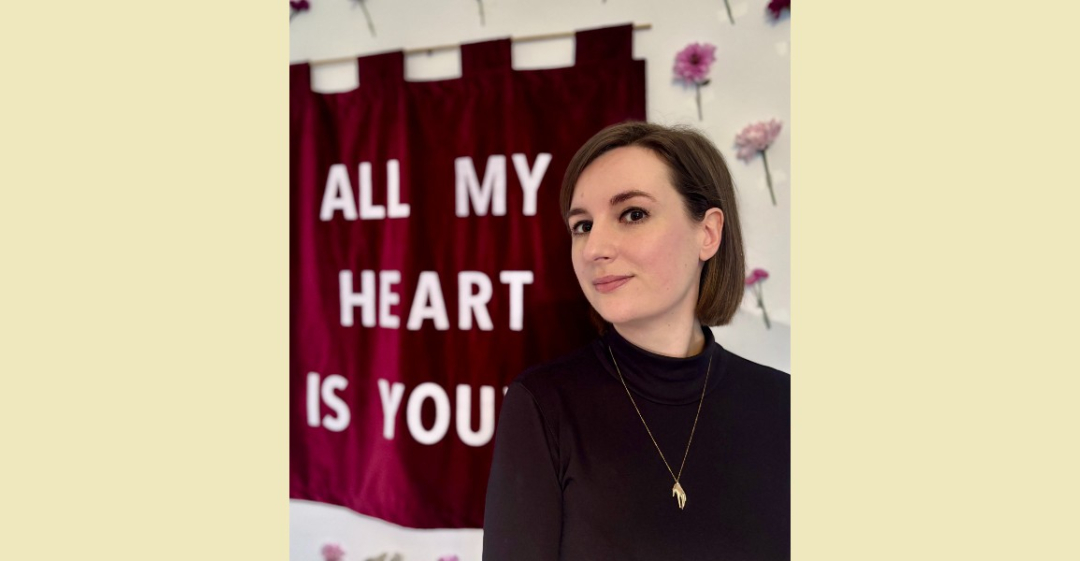
I’m a textile artist.
I create bespoke handmade velvet banners with meaningful words for alternative weddings, unique homes and as memorial keepsakes.
I also have my own personal textile-based art practice, scaling up small intimate handwritten notes into big celebrations of vulnerability and have been very lucky to have pieces in several exhibitions.
Why did you change?
Looking back, I think there had always been a quiet underlying sense that something wasn’t right.
That was brought into sharper focus following my partner Dave’s diagnosis with Becker Muscular Dystrophy (a rare progressive muscle-wasting condition) in 2023.
In the year that followed, we navigated a lot. Dave leaving his career due to disability discrimination, my role being made redundant and starting a new job.
We also tried to rush through renovating our flat so we could sell and relocate to a bungalow. All while we were both learning what Becker Muscular Dystrophy was and coming to terms with it.
Whilst there were a lot of difficult moments that year, Dave was incredibly fortunate to start on a clinical drug trial which was such a positive part of coming to terms with his diagnosis.
Taking charge and participating in something which might lead to a greater scientific understanding for a possible future treatment. The dedication and care from the team at the Royal Victoria Infirmary in Newcastle was (and continues to be) awe-inspiring.
Dave’s diagnosis also brought out the best in some of the people around us – with a true outpouring of love and support from family and friends. I feel so fortunate that we have the most wonderful people in our lives.
I think, as humans, we have an incredible ability to adapt and I quickly “normalised” what was an enormous life-change. My priority was making sure Dave was okay and working through the practical challenges of future-proofing.
I'd been struggling for a while in 2024 and tried highlighting this at work but didn’t advocate strongly enough for myself. I vividly remember being told everyone has a personal life, that I just have some “additional pressures”.
That phrase weighed heavily on me, reinforcing the sense that I should be coping better.
It all came to a head that summer, when some odd symptoms (unexplained pain, brain fog, exhaustion) led me to think I was physically unwell. I'm so grateful to the doctor who saw how unwell I was. She recognised my need for some time and I was ultimately signed off work for about 10 weeks.
I cried with relief when I left the doctor’s surgery. The real “additional pressure” had been lifted.
That time off gave me the space I needed to feel better – to properly process Dave’s diagnosis, grieve our old life and clearly see I couldn’t remain in my current work, but that it wasn’t going to be an immediate change.
I returned to work and quickly realised I could cope with the big life changes but not alongside the work I was doing!
When was the moment you decided to make the change?
There were two key moments.
The first was being signed off work and realising how much better I felt. This was the sign I needed to make a change. I had a sense I could maybe cope better if I was a baker or decorator or doing something that would give me the space to think.
Whereas, my work involved a lot of complex systems and processes, all with their own quirks and nuance and my brain ultimately couldn’t handle the complexity.
Alongside that, I was so inspired by the clinical trial hospital visits – the compassion and care shown by the team at the RVI in Newcastle. In a strange way, I felt more comfortable in that environment than I did at work.
The second point was my first step towards making a change. In January 2025, we’d not long moved to a bungalow in Newcastle so it felt like some of the practical elements of our new life were in place.
I had a garden for the first time and spent a lot of time there over that winter. I felt like I came alive in the garden, getting my hands dirty, doing physical work and enjoying the birdsong. I loved the slower pace – accepting that nature works on its own schedule and nothing was urgent.
My work didn't fit with this new life that valued patience, compassion and care. I had no idea how to go about making a career change or what I wanted to do next so I went to see a counsellor, thinking it might help.
She listened to me describe my life and then reflected back an image of someone who was miserable and lost. I didn’t want to be the person she described, so I sought help and found Careershifters.
This was the point I was fully committed to make a career change, whatever that was going to end up being!
How did you choose your new career?
I had no idea what I wanted to do next other than I wanted to feel “human”. In my mind, that meant working with my hands, in nature or helping people.
I joined a Careershifters workshop in early 2025 and it left me buzzing with excitement – there’s a way to work out what you want to do next! I signed up to the Careershifters Launch Pad which started in April.
The Launch Pad was everything I needed – space to explore in a light, fun way. After the previous year, I really really needed that space to play! I explored possible careers as a gardener, career coach and celebrant.
Even though they weren’t “right”, they were very helpful clues and markers along the way, helping steer me forward.
There was so much within the Launch Pad, but I think the key part for me was the shift in mindset. It enabled me to gain the most from the things I explored and conversations I had.
I granted myself permission to want things, challenged assumptions I had about myself, became comfortable with asking for help and wasn’t afraid to “fail”.
Through exploring careers in horticulture, I was drawn to the idea of therapeutic horticulture but realised that this was actually reflecting what the garden was to me – something to help my wellbeing and I wanted to keep that as a hobby.
By going through the Launch Pad process, I realised that there were key things I loved but had lost sight of – fabric and meaningful words (song lyrics, poetry etc). Words have huge resonance for me and I started making banners with meaningful words.
Traditionally a way of uniting a community, I loved the idea of creating them to celebrate emotions and feelings. Because I had studied Fashion Design at college and university, sewing had an association with work already so I wasn’t worried I would lose the enjoyment of it.
I then had a bit of an internal battle on where I should focus my time – on making commissioned bespoke banners or on my own art practice.
Speaking to a business advisor was really valuable in seeing that the bespoke banner business needed to be the main focus in order to create the time and space for my personal art practice.
Are you happy with the change?
I honestly can’t believe how incredibly lucky I am to have found something I love this much.
I now live in a world of words where I’m trusted to make something beautiful from people’s cherished stories.
It’s such a privilege. I'm completely myself every day – caring and sentimental, but creating something tangible.
Whilst I'm running a business, I don’t feel I’m “going to” or “finishing” work every day. It feels a natural part of my day and I can work at the pace and rhythm that suits me – spending an hour gardening to make the most of it being a lovely morning then sewing into the evening.
To create takes patience and I love spending that time and care to ensure a banner is finished beautifully and the letters are perfectly aligned.
I’ve found a wonderful community in Newcastle, of other artists and people who run their own businesses or work freelance. It’s amazing to have the balance of being able to meet up with like-minded people but also have time to myself, music on and completely immersed in my work.
One of my favourite things about my shift is that people will send me messages with a quote, sign or meaningful words they’ve come across – knowing I will enjoy them. That thoughtfulness is always really touching.
The other lovely thing is the ripple effect that seeing me exploring new things has inspired Dave to try (and discover a new love of) pottery and ceramics. I can’t wait to see where it takes him.
2026 is looking very different. I’m exhibiting at four wedding fairs and the National Funeral Exhibition. The old me would never believe that, it would have been unthinkable! I'm so excited to meet people and hear about their meaningful words and stories.
What do you miss and what don't you miss?
The only thing I miss is the monthly salary, but it’s early days for my business and I’m determined to reach the point where I have a reliable income.
I don’t miss anything else! I now feel completely free to be myself and don’t think I’d realised how far I’d drifted from who I am.
How did you go about making the shift?
When I started the Launch Pad in April 2025, I reduced my hours to work 4 days a week.
This gave me more time and space to focus on my career explorations, and then later on my shift.
From the Launch Pad, I gained clarity and momentum which I built on. It started with small experiments – sewing a small textile piece, then a larger one. Removing my fear of failure, I started applying to art open calls and had a piece accepted into a gallery (The House of Smalls in Edinburgh).
I went to local events: art networking, workshops on setting up a business, pushing past imposter syndrome. This was really key in both meeting like-minded people and recognising that these were environments where I fit in.
I created a website. It was rough at first, but adding to it and updating as and when I had more or better images and copy. Small iterations rather than waiting until it was perfect before starting.
Alongside that, I started posting on social media – something I’d avoided for years and the idea of which had made me cringe! Now it felt different, I had nothing to cringe about because I was just being myself, sharing and talking about what I love.
How did you develop (or transfer) the skills you needed for your new role?
It was a real mixture.
I tapped back into my creative thinking by recognising what I was drawn to and interested in, all the little clues that pointed to the person I’d forgotten I was.
It’s amazing the ideas that appear (usually mid-shower) when you’ve been absorbed in lots of things you genuinely love and feel excited about – the way your brain finds those hidden connections.
At college and university, I studied Fashion Design and had been sewing for over 20 years so I had the technical skills. From working, I had the benefit of transferable ecommerce and marketing skills to build my website.
Experience as a project manager definitely helped too – breaking down work into smaller steps and being someone who likes getting things done!
I didn’t know how to run a business and found some amazing support through local organisations (PNE and the Millin Charity). This really helped plug the gaps I had around business finances and even thinking about what I wanted to do as a business helped it feel more “real” and achievable.
What didn’t go well? What wrong turns did you take?
I don’t think there were wrong turns as they provided valuable lessons along the way but there were other career paths I explored.
The first was horticulture – given how much joy I found from being in the garden. I had some incredible conversations with different people in horticulture and found everyone to be so generous and compassionate.
I also loved that there was no gatekeeping. Everyone wanted to talk about plants and was very happy to signpost to other organisations.
The other key part for me with the garden was about play. The garden was a space to try things without fear of failure and to accept you can’t control everything. This was a key mindset shift for my career change – almost a “let’s see what happens if I plant this seed”, exploring curiosity and giving it a go.
Another career I was curious about was being a celebrant. I had a wonderful chat with Sarah Clarke (Sarah Clarke Celebrates) after reading about her career change in Positive News magazine. That was key in recognising why I was drawn to the idea – being close to emotional celebrations where words hold a lot of meaning, but public speaking isn't for me.
The final career I considered was coaching. A key part of the Launch Pad experience for me had been supporting others on their career change journeys. I found it so rewarding and recognised I loved being able to ask questions that prompted reflection or provide an alternative perspective. Again, the impact and power of words being a key thread for me.
Coaching wasn’t for me either, but I recognised that the skills of asking good questions, providing perspective and almost playing with possibility was creative thinking presenting itself in a different setting.
Even though these careers weren’t right for me, exploring them provided key clues and it’s so inspiring to speak to people who love their work. You feel their enthusiasm radiate!
How did you handle your finances to make your shift possible?
With reducing my hours at work, I'd been used to a slightly reduced salary for the months before.
I was in the fortunate position to have savings that allowed me to leave my role when I was ready to in October 2025.
Being self-employed, there’s no guaranteed salary, but I'm committed to making my business successful and if I need to seek out part-time work alongside it at any point, I’ll do that.
What was the most difficult thing about changing?
Challenging a lot of the assumptions I had about myself was really difficult.
I’d always assumed I was awkward and terrible at speaking with people but realised it’s because I was mostly doing that at work. Of course I felt awkward talking about work I wasn’t interested in!
Getting out and meeting people who care about the same things – having wonderful human conversations and real connection is what I needed. I absolutely found this through speaking to gardeners and meeting other artists! Lovely people who care about the most fundamentally human things – creating art, ideas and being in nature.
It was also hard to recognise myself as an artist. I thought that was something that other people who are much cooler and more interesting than me were able to do!
Ironically, once I could eventually see myself as an artist, the bit I found most difficult was staying in my job. It felt like living a double life where I was having to keep my true identity hidden.
I worked remotely which, thankfully, meant I could somewhat hide how much I was physically squirming and fidgeting out of discomfort in meetings!
What help did you get?
During the Careershifters Launch Pad, support from our amazing group in encouraging and supporting each other and from career coaches Natasha and Anna.
I had a lot of interesting curiosity-driven career conversations and really appreciate all the people who were very generous with their time.
I also had support from my partner, family and friends who were very patient and kind as I chewed their ears off working through my career explorations, little “aha” moments and realised things that were probably obvious to them.
A chat with my closest friend Faye, where I had the revelation that words are important to me and she laughed and pointed out my three teenage tattoos were all poetry and song lyrics: “Louise, you literally have words tattooed on you”. The clues were there all along!
What have you learnt in the process?
So much.
I’ve rediscovered who I am. Someone who is deeply compassionate and caring, creative and sentimental and now able to embrace and celebrate that in all aspects of their life.
I don’t think I realised how much I’d compromised myself at work over the last 10 years and it feels amazingly freeing to be able to be myself.
On the career change process – the balance of being open to all possibilities but committed to the process, served me well. Going in wholeheartedly and willing to take a very different approach!
Asking for help is key. It can help you find answers more quickly and people are usually flattered and delighted to help you.
What do you wish you'd done differently?
I don’t think I’d change anything.
Everything happened at the right time for me. I was absolutely committed to making a career change and throwing myself wholeheartedly into the process – which has completely changed my life!
What would you advise others to do in the same situation?
Seek out like-minded people who are also motivated to make a change!
I felt so isolated thinking I was the only one in the wrong career. To hear other people describe the same feelings was pivotal. You’re not alone and it’s so much easier and more enjoyable to go through career change together.
Plus, you have the privilege of cheering others on as they make progress. One of my favourite parts of the Launch Pad course was hearing about all the amazing exciting things our group were up to and seeing people have breakthrough moments along the way.
Trust yourself. You don’t need to have the answer now, but trust that by taking action, you’ll find what you want to do and you will make your shift happen.
Have a play! Do something fun and enjoy yourself. I found my old career drained my energy, but once I started seeking out some new fun things that I enjoyed, it gave me so much energy. This helped motivate my career change and ultimately reach clarity in what I wanted to do.
What resources would you recommend to others?
Careershifters have been incredible.
I’d highly recommend the Workshop and Launch Pad. I can’t overstate how transformative it’s been for me!
Positive News is an amazing source of ideas, inspiration and generally a joy to read, especially when feeling stuck. It was really helpful in opening my eyes to lots of careers and organisations I wouldn’t have known existed.
Ask friends and family if they know anyone that works in something you’re curious about. Having even a quick chat can be so valuable.
If you’re interested in starting a business, see what support is available locally. There’s often free workshops or business advice. The BIPC is a great place to start.
To find out more about Louise's business, visit https://www.louisebrooke.com/
What lessons could you take from Louise's story to use in your own career change? Let us know in the comments below.
Louise took part in our Career Change Launch Pad. If you're ready to join a group of bright, motivated career changers on a structured programme to help you find more fulfilling work, you can find out more here.